CEOs celebrate soy on national webinar
11.20.2026
In her first month leading the United Soybean Board (USB), CEO Courtney Knupp set a clear standard for the Soy Checkoff℠.
“The real measure of success is not the research report sitting on a shelf,” Knupp says. “It’s whether that research leads to a customer buying more U.S. soybeans.”
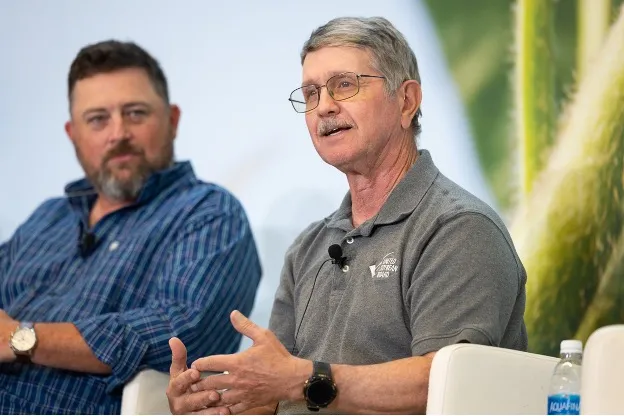
Knupp spoke during “Three CEOs, One Soybean Future,” an Agri-Pulse webinar Oct. 29 with Steve Censky, CEO of the American Soybean Association, and Jim Sutter, CEO of the U.S. Soybean Export Council.
A steady hand in a tough year
Knupp, who grew up on her family’s Iowa farm, acknowledged the pressure farmers face. “Input costs are up,” she says. “Farmers are having hard conversations about cash flow. That’s why the checkoff matters more now than ever.”
She pointed to an independent study showing every checkoff dollar returns $12.30 to farmers. “Every dollar started with farmers. It belongs to farmers, and it should come back to the farm as value,” she says.
For fiscal year 2027, which began Oct. 1, USB’s 77 farmer-leaders are focused on strengthening and diversifying demand and on moving research into the marketplace.
Calculated bets that paid off
Biodiesel is a model of how it should work. “It’s a market that didn’t exist until soybean farmers invested their checkoff dollars in it,” Knupp says. Twenty years ago, biofuels used fewer than 100 million bushels of soybeans. Today they use about 1.2 billion. “That’s what a calculated bet looks like when it pays off at the farm gate.”
She also cited checkoff-funded research that helped lay the groundwork for deepening the lower Mississippi River, letting each ocean vessel carry about 500,000 more bushels. A $2 million checkoff investment, she said, now adds about $461 million in value every year.
Domestic demand research returns $42.88 per checkoff dollar, the highest of any category. More than 1,000 soy-based products are on the market, and about 400 fire departments now use SoyFoam, a firefighting foam made without PFAS “forever chemicals.”
“I don’t believe that we should just be looking for one silver bullet to drive soybean demand,” Knupp says. “Our strengths truly come from having multiple customers, multiple markets, multiple uses for the soybean.”
Three organizations, one goal
Censky said each organization works independently but all share one goal: “to improve the success of soybean farmers.” He noted that U.S. crush capacity has grown more than 25% in five years.
“When you have a new crush plant that goes in or expanded crush, that improves the basis for soybean farmers,” Censky says. He also pointed to Soy Checkoff-funded research by economist Jayson Lusk, then at Purdue University, which found that crushing more soybeans for oil also puts more meal on the market, helping keep meat, milk and eggs affordable.
Sutter said more than half of U.S. soybeans are exported as whole beans, meal or oil. As more oil goes into biofuels, more meal needs a home. U.S. meal exports have run about 12 million tons a year, and he said the council expects that to double within 10 years.
“We need to find more homes for meal, but we think that they’re there,” Sutter says.
The Philippines is the top U.S. meal market, with growth coming in Indonesia, Thailand and Vietnam. In Egypt, buyers have built a strong preference for U.S. soybeans because of their quality.
Sutter also highlighted the council’s Soy Excellence Centers, funded by Qualified State Soybean Boards and the Foreign Agricultural Service, which have trained 25,000 early-career workers in five years. Those trainees, he said, will be “the buyers of U.S. Soy around the world 10 years from now.”
The right work
Knupp’s message for farmers was simple. “Our priority is not just doing good work, but doing the right work,” she says. “It’s work that’s aligned with your priorities as farmers, that delivers measurable outcomes and creates long-term value for the industry.”
Farmer resources are available at the Soy Farmer Support Hub at soycheckoff.org.
Related News
From the grain elevator to Greenbuild: An Ohio farmer sees the Soy Checkoff at work
Farmers as Ambassadors: Building Trust in U.S. Soy Around the World
This National Pork Month, winter feeding decisions can help producers beat the summer dip